
The Geoscience Application Process
To apply for licensure as a professional geoscientist, follow these steps.
Create your account and start your application.
Create a myAPEGA account and upload the required information. You will enter your work experience in Step 6 using the online forms.Complete and submit your Work Experience Record (WER) and then pay your application fee (within 90 days).
You must submit your WER and pay your application fee within 90 days of starting your application. If you miss this deadline, your application will be deleted and you will need to start again.Complete and submit your Competency-Based Assessment Tool after you have submitted your WER.
Submit your academic records (within 90 days of payment).
After you pay the application fee, submit at least one academic record within 90 days. If you miss this deadline, your application will be withdrawn.
Once APEGA has received all required documents—including your conferred transcripts, WER, and CBAT—your application will be queued for review. An APEGA staff member will process your submissions and send out required forms for your references and validators. Once the staff member has received all the requirements and the application is complete, they will forward your application for formal review.
Work Experience Requirements
The work experience portion of your application is composed of two components: the Work Experience Record (WER) and the Competency Based Assessment Tool (CBAT). These electronic forms are accessible through your myAPEGA portal and are only available to applicants who have started a professional geoscientist application. You must complete and submit both for your application to be considered complete. You will also need references and validators—in most cases, your references can also serve as your validators.
| Role | Responsibility | Professional Background | Number Required |
|---|---|---|---|
| Reference | Confirms employment, duration, and position(s) |
| At least one for each position |
| Validator | Validates and scores each listed competency | Expected to be a professional geoscientist, a professional engineer, or a practitioner1 in geoscience who has reviewed the applicant's technical work. | At least three |
1. Practitioner: A non-P.Geo. that has an geoscience degree and (4 or more years of) professional geoscience experience.
Work Experience Record (WER)
You will detail your professional history on the WER. Unlike the CBAT, which proves proficiency in 29 key technical competencies, the WER focuses on your career timeline and overall professional-level work experience.
The WER includes dates of employment, employment position titles, responsibilities, and reference information. We recommend that you complete the WER before you complete the CBAT.
Any work experience used in the competency demonstration must be entered in the WER.
You must provide at least 48 months of geoscience experience supported by references. When completing your WER:
- include all relevant experience
- explain how and where you personally applied geoscience theory in each position overview
- list work experience in reverse chronological order
- separate work periods by job title or employer, not by project
- identify the role, responsibilities, and types of geoscience activities for each role.
- specify the types of codes and standards used
- describe how you adjusted designs for cold temperatures, if applicable
- describe familiarity with Canadian practices within your profession if the work experience is from outside Canada
- list all gaps in employment, including parental leave, unemployment, education, or non-geoscience work. You do not need to provide details or references for these positions. If any gaps are not listed, APEGA will contact you to request the missing information, which may delay processing
Professional-level experience includes reporting, advising, evaluating, interpreting, processing, geoscientific surveying, exploring, classifying reserves, and examining in relation to any activity that:
- relates to the earth sciences or the environment,
- is aimed at the discovery or development of oil, natural gas, coal, metallic or non-metallic minerals, precious stones, other natural resources or water or that is aimed at the investigation of surface or subsurface conditions of the earth
- involves the professional application of the principles of mathematics, chemistry, physics, or biology, or
- involves teaching geoscience at a university
Professional-level experience includes reporting, advising, evaluating, interpreting, processing, geoscientific surveying, exploring, classifying reserves, and examining in relation to any activity that:
- relates to the earth sciences or the environment,
- involves the professional application of the principles of mathematics, chemistry, physics, or biology,
- involves teaching geoscience at a university, or
- is aimed at the discovery or development of oil, natural gas, coal, metallic or non-metallic minerals, precious stones, other natural resources or water or that is aimed at the investigation of surface or subsurface conditions of the earth
The APEGA Board of Examiners (BOE) emphasizes:
- the ability to apply geoscience principles
- demonstrated technical proficiency
The BOE will consider increased technical competency and increasing levels of responsibility when evaluating your experience.
If you have not acquired experience in the last seven years, you may be assessed additional experience by the Board of Examiners.
References for Geoscience Applicants
As part of your application to become a professional member or licensee with APEGA, you must provide references in your WER who can confirm your professional work experience. You must provide a minimum of 48 months of work experience, and all experience submitted towards this requirement must be verified by a reference.
A reference is a person who can confirm your position and the duration of your experience with a company. You must provide at least one reference for each employer.
Reference Information
You will provide reference names and current contact information in the spaces provided on your WER. It is your responsibility to ensure this information is correct and confirmed with your references before submitting your application.
- Use a professional licensee (engineering or geoscience) or professional technologist (engineering or geoscience) as a reference only if their area of practice aligns with yours.
- Provide a reference’s current, detailed résumé if they are not a registered professional member with a Canadian engineering regulatory body. The résumé must include:
- relevant education, including program and graduation dates
- work history, including employment dates, duties, and responsibilities
- applicable professional designations, past and present
References can email their résumés to [email protected] with your name and APEGA ID in the subject line. They can submit their information within the email body or as an attachment (such as a PDF or Word document).
- Create a work record for each reference if multiple references are provided for the same position.
- Ensure that appropriate references are used and that all required information is provided. Failure to do so may result in your application being deferred.
If you need to change a reference or update contact information after submitting your application, email the APEGA staff member assigned to your application and include:
- your APEGA ID
- your reference's name
- the information you wish to change
Notifications
Once APEGA staff processes your Reference Questionnaire (RefQ), you will receive a notification and the requirement will appear as received in your myAPEGA portal. It is your responsibility to ensure your references submit their questionnaires within the required time frame, so we encourage you to communicate with them regularly.
Competency-Based Assessment Tool (CBAT) for Geoscience Applicants
The CBAT is a digital form designed to capture your understanding and achievement of the 29 key competencies required for registration as a professional geoscientist.
The CBAT must be completed after you have finished and submitted your WER.
Any work experience used in the competency demonstration must be entered in the WER.
DOWNLOAD THE GEOSCIENCE CBA GUIDE
What Are Competencies?
Competencies are skills or knowledge that APEGA has identified as crucial to the professional practice of geoscience. They are based on your decisions, behaviours, and applications of skill or knowledge and are divided into four categories:
1. Professionalism
2. Scientific Methods
3. Areas of Geoscience Practice
4. Complementary
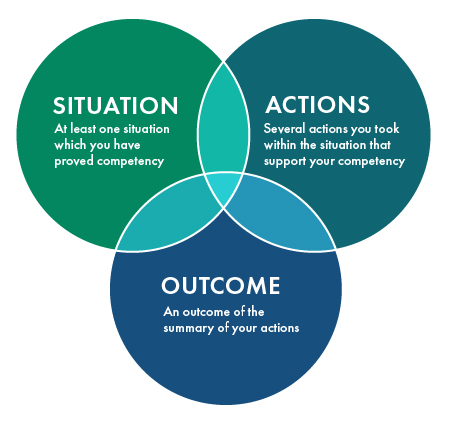
To demonstrate your level of skill in each key competency, you must draw examples from your previous geoscience experience to include in your CBAT. When completing each page of the form, provide the following.
- Situation: At least one situation in which you have proved the competency.
- Actions: Several actions you took within the situation that support your competency.
- Outcome: An outcome of the summary of your actions. This should include a basic summary of the solution, product, process, or other outcome of the situation and the actions.
The CBAT includes skills and behaviours called indicators. Indicators are:
- generalized examples that help you illustrate how you have achieved a given competency
- not required to be fully met for you to be deemed competent
- a framework provided by APEGA to help you determine which aspects of your work experience apply to each key competency
- a tool for identifying potential gaps in your experience
Include specific details of your work experience for every competency. Do not copy and paste the generic indicators provided.
Read more about CBAT Competencies and Indicators
APEGA’s Board of Examiners (BOE) will assess your competency using only the information you and your validators provide. Focus on:
- describing your technical and theoretical skills and knowledge and how they contributed to actions that positively or negatively affected the outcome
- providing details about the decisions you made
- writing in first person (“I” statements instead of “we”) to show ownership of your actions
Validators for Geoscience Applicants
Validation of work experience must be completed by a validator—someone who assesses your competencies and verifies that the work description is adequate and was completed by you. You need at least three validators for the CBAT.
Each validator will be asked to score and comment on your ability in each assigned competency and must therefore have:
- direct knowledge of your work
- provided you with suitable professional supervision throughout the work period being validated
- reviewed your work
An indirect manager providing a high-level review may not have adequate familiarity with your work.
-
- Validators for the Professionalism, Scientific Methods, and Areas of Geoscience Practice categories must have reviewed your technical work.
- If your competencies in these three categories are demonstrated from work in Canada, they must be validated by a professional geoscientist or a professional engineer.
- If you have competencies from outside of Canada, they must be validated by an equivalent practitioner to a professional geoscientist. Your validator may be asked for proof of credentials.
Validators are expected to hold a professional geoscience or engineering designation from a Canadian jurisdiction. Those with a different professional designation may be considered if their designation has a practice area or scope of practice that includes the applicable competency. This includes professional licensees, and professional technologists.
For the Complementary category, a validator who is a professional geoscientist or who is otherwise a practitioner in geoscience is preferred.
A practitioner has a degree in geoscience and four or more years of professional geoscience experience but is not a professional geoscientist.
-
Validators for the Professionalism, Scientific Methods, and Areas of Geoscience Practice categories are expected to have reviewed your technical work.
- If the validator does not hold a professional geoscience designation with a Canadian geoscience association, they are expected to be a practitioner in geoscience with equivalent credentials to a professional geoscience designation:
- a bachelor's degree or equivalent in a geoscience discipline
- at least four years of geoscience work experience
- Validators should clarify their geoscience credentials by providing their current detailed résumé.
For the Complementary category, a validator who is a professional geoscientist or who is otherwise a practitioner in geoscience is preferred.
-
- Family members or relatives.
- Individuals who don’t have direct knowledge of your work.
The acceptability of the validator is at the BOE’s discretion. The acceptability (education and experience) of the validator is based on when the validation forms are completed, not when the competency is demonstrated.
Competency-Based Assessment Tool Evaluation Criteria
Scoring
Each competency will be evaluated on a scale from 0–5.
- 0 demonstrates no awareness in the competency
- 5 demonstrates a mature level of practice in the competency
Read More About Competency Scoring
Details of Example
The details of the examples should emphasize the application of theory and practical experience.
Application of theory in your respective discipline must include:
- selecting solutions and solving problems
- preparing and checking designs and interpretations
- providing evidence of sound technical judgement and practices
- demonstrating familiarity with the use and application of pertinent technologies, procedures, systems, and programs
Although the experience can include collecting and analyzing information and data, these should not be major components.
Practical experience must include:
- being exposed to work-site operations
- recognizing limitations in designs, interpretations, or recommendations, and understanding the application of pertinent codes and regulations
- understanding the interdependence of disciplines, systems, and activities, and developing working relationships
The BOE will consider increased technical competency and increasing levels of responsibility when evaluating your experience.
If you need any forms to be resent to your references or validators, please email the APEGA staff member assigned to your application. APEGA staff cannot accept requests by telephone or in person.
To maintain the integrity of the application process, APEGA conducts quality assurance audits and may independently verify reference responses by phone, email, or other means. These measures help ensure that work experience and references provided in applications are accurate. If concerns arise regarding the accuracy or authenticity of information submitted, APEGA will review the matter in accordance with its established processes.
All forms are confidential and are not released to applicants unless an application has been refused and the applicant requests a Section 32 Appeal. In the event of an appeal, the Registration department must provide the Appeal Board with the complete application record.
Areas of Experience the BOE Looks For
Application of Theory
At least two years of application of theory in your respective discipline, which must include:
- selecting solutions and solving problems
- preparing and checking designs and interpretations
- applying sound technical judgement and practices
- demonstrating familiarity with the use and application of pertinent technologies, procedures, systems, and programs
Although your experience can include collecting and analyzing information and data, these should not be the major components of your experience.
Management
Your management skills must include:
- managing project resources
- planning, scheduling, budgeting, and controlling costs
- developing team skills and understanding professional and business ethics
- keeping appropriate ethics
Your experience can include developing an understanding of corporate structure, legal aspects of contracts, quality-assurance programs, and cost-impact studies.
Practical Experience
Your practical experience must include:
- being exposed to work-site operations
- recognizing limitations in designs, interpretations, or recommendations, and understanding the application of pertinent codes and regulations
- understanding the interdependence of disciplines, systems, and activities, and developing working relationships
Societal Implications
Your experience must show evidence that you are familiar with:
- professional and public safeguards
- the ways engineering or geoscience benefits the public
- the roles and responsibilities of regulatory agencies in your specific field of professional practice
Communication
Your communication skills must include:
- writing technical reports
- making presentations to management, peers, or the public
Different Experience from Degree
If your experience is in a field other than your degree (e.g., a geology graduate working in engineering) the BOE may require you to obtain:
- substantial academic upgrading
- experience beyond the 48-month requirement
- both academic upgrading and additional experience
The requirement for academic upgrading or additional experience will depend on the APEGA designation for which you are applying. Your experience should be related to your degree.
The BOE may also give credit for pregraduate work experience and postgraduate work experience.
Read About Pregraduate Work Experience Read About Postgraduate Work Experience