
-
Professional engineer application changes
Competency-Based Assessment Scoring for Engineering Applications
The competency-based assessment scoring scale is used to rate your ability to perform engineering functions.
In your application, you must demonstrate professional-level experience and expertise across 22 key competencies. Each competency is rated on a scale from 0–5. You will provide a self-assessment for all competencies using the online Competency-Based Assessment Tool (CBAT).
Eight of the 22 competencies (1.1, 1.6, 1.9, 2.1, 2.2, 2.3, 5.1, and 6.2) are designated as Canadian environment competencies. They demonstrate knowledge experience of Canadian regulations, codes, standards, quality control, safety awareness, professional accountability, and communication.
Your validators will review the examples assigned to them and will provide scores based on their assessment of your abilities during the period in which they reviewed your technical work. A validator must have direct knowledge of your work and must have provided sufficient review to be familiar with the details of the work. An indirect manager who provided only high-level oversight may not have adequate familiarity with the work.
The overall average within each competency category must also meet or exceed the required minimum.
Read About the Competency-Based Assessment Tool
Category 1: Technical Competency
Required category score (average across all competencies): 3.0
The scoring system to rate your abilities in technical aspects of your work is as follows.
| Score | Description of Competency |
|---|---|
| 0 | Little or no exposure to the competency. |
| 1 | Training level: demonstrates a general awareness and basic understanding of the competency. |
| 2 | Demonstrates knowledge and understanding of objectives, and applies standard engineering methods and techniques to solve problems. |
| 3 | Completes assignments of moderate scope and complexity and shows readiness to take on professional engineering responsibilities. |
| 4 | Carries out responsible and varied assignments requiring familiarity with a broad field of engineering and knowledge. |
| 5 | Applies advanced engineering knowledge, demonstrates independent judgement, and coordinates complex and high-responsibility assignments. |
Validators for category 1 are expected to hold a professional engineering designation from a Canadian engineering association for work done in Canada or be an acceptable engineering practitioner for work completed outside Canada. Refer to the CBAT for more information on acceptable validators.
Categories 2-6: Non-Technical Competencies
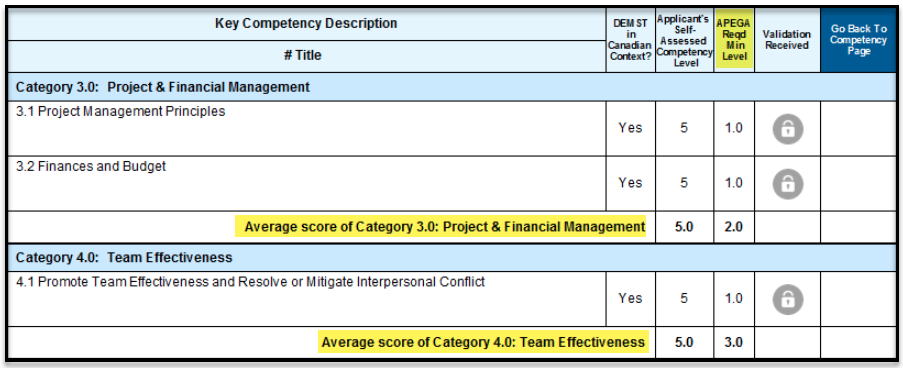
The minimum average competency levels for each category are as follows:
| Category | Required Category Score* |
|---|---|
| 2. Communication | 3.0 |
| 3. Financial and Project Management | 2.0 |
| 4. Team Effectiveness | 3.0 |
| 5. Professional Accountability | 3.0 |
| 6. Social, Economic, and Environmental Accountability | 2.0 |
* Minimum average score across all category competencies
The scoring system to rate your competency in each category is:
| Score | Description of Competency |
|---|---|
| 0 | Little or no exposure to the competency. |
| 1 | Training level; demonstrates a general awareness and basic understanding of the competency. |
| 2 | Limited experience: carries out activities of limited scope and complexity and demonstrates knowledge and understanding of objectives. |
| 3 | Approaching a professional level; carries out activities of moderate complexity. |
| 4 | Working at a professional level; carries out responsible and varied activities. |
| 5 | Working at an advanced professional level; coordinates complex activities independently, demonstrates independent judgement, and coordinates difficult and high-responsibility assignments. |
The minimum required score for each competency is indicated in the competency descriptor within the CBAT. If your self-assessment score is lower than the minimum score for each key competency or the required overall average level for each competency category, you will not meet APEGA's minimum eligibility requirements and will be unable to submit the CBAT. The Canadian work environment competencies have specific independent minimum scores.
As per the Engineering and Geoscience Professions Act, APEGA's Board of Examiners (BOE) is the decision-making body on all applications for membership with APEGA. The BOE's review and final decision are based on your academic credentials, relevant work history, demonstrated core competencies, and validator feedback.