APEGA regulates engineering and geoscience

Our main regulatory function is licensing individuals and companies that want to practise engineering and geoscience in Alberta.

Learn who we are

Apply for a licence to practise

Find out which membership type you should apply for.

Start your application

Published discipline decisions

APEGA registrants are required to practise engineering and geoscience skilfully, ethically, and professionally. APEGA investigates written complaints from registrants and the public.

Read recent decisions

Regulatory

  • Discipline Decisions & Orders

    APEGA publishes discipline decisions and recommended discipline orders resulting from unprofessional conduct or unskilled practice by registrants.
  • Standards, Bulletins, and Guidelines

    APEGA's practice standards, bulletins, and guidelines explain the roles and responsibilities of professional members.
  • APEGA Annual Report

    Each spring, prior to the annual general meeting, APEGA produces a report of its activities, statistics, and finances, which it submits to the Government of Alberta.
  • Professional Practice Management Plan (PPMP)

    Enforceable as of May 1, 2023, this practice standard outlines the required parts of an APEGA permit holder's PPMP.
  • Continuing Professional Development

    This mandatory program ensures the health, safety, and welfare of the public by requiring that professionals engage in lifelong learning on an annual basis.
  • Good Standing

    Learn about APEGA's criteria for determining whether members and permit holders are considered in good standing.

Do You Need a Licensed Professional or a Technologist?
APEGA

The work of engineering and geoscience is vast. It can range from collecting data to determining if the ground is safe to build on. Some of this work can be done by technologists and technicians; some must be done by licensed professionals. As a project manager, it can be challenging to know which you need, yet it’s critical that you do.

What’s the Difference?

Although licensed professionals and technologists both perform work within the practice of engineering or geoscience, technologists can’t do the work of licensed professionals. The difference is licensed professionals work independently and take responsibility for their work, whereas technologists must work under the supervision of a licensed professional.

What’s in a Name?

Licensed professionals

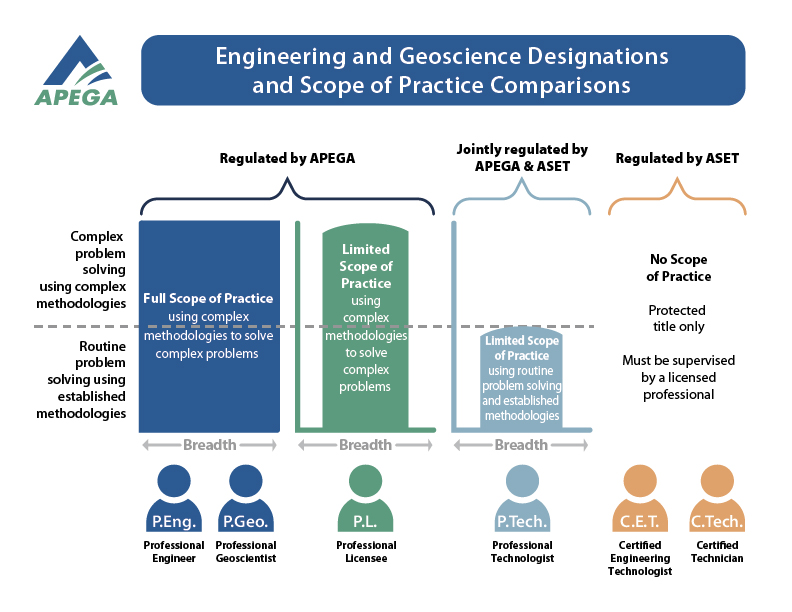
Due to their advanced education and extensive experience, licensed professionals can work independently. They can solve complex problems using complex methodologies, and they have the legal right and requirement to take responsibility for their work.

Professional engineers and geoscientists are licensed to practise within the full scope of practice as defined in the Engineering and Geoscience Professions Act with no limitations.

Professional licensees are licensed to practise within a restricted scope of practice within engineering or geoscience.

Professional technologists are licensed to practise within a restricted scope within engineering or geoscience that is further limited to routine application of industry-recognized codes, standards, procedures, and practices using established engineering or applied-science principles and methods of problem solving.

Certified Engineering Technologists and Certified Technicians

Certified engineering technologists (C.E.T.s) and certified technicians (C.Tech.s) are key parts of engineering and geoscience teams—an integrated team that operates within a single spectrum of practice. C.E.T.s and C.Tech.s must work under the supervision of a licensed professional who will verify the quality and results of the work and take responsibility for it. They typically work within the routine application of engineering and geoscience procedures and practices.

In addition, technologists and technicians have no defined scope of practice. By law, their work must be assigned, supervised, and approved by a licensed professional.  
scope-of-practice-comparisons

Note: ASET stands for the Association of Science and Engineering Technology Professionals of Alberta.

Which Work is Being Done?

You may not always need a licensed professional. It will depend on the work being done. For example, sampling, measurement, visual inspection, repair of equipment, and operation of equipment may not need a licensed professional. You can check with a licensed professional to assist you in understanding the work being done.


Where to Learn More

Visit www.apega.ca/government to learn more.

To check if someone is a professional engineer, geoscientist, or licensee, visit our member directory. You can also see the scopes of practice for professional licensees.

If you’re still not sure which professional your project should use, contact [email protected]. We’re here to help. 

Articles

Top Articles

Do You Need a Licensed Professional or a Technologist?

APEGA

The work of engineering and geoscience is vast. It can range from collecting data to determining if the ground is safe to build on. Some of this work can be done by technologists and technicians; some must be done by licensed professionals. As a project manager, it can be challenging to know which you need, yet it’s critical that you do.

What’s the Difference?

Although licensed professionals and technologists both perform work within the practice of engineering or geoscience, technologists can’t do the work of licensed professionals. The difference is licensed professionals work independently and take responsibility for their work, whereas technologists must work under the supervision of a licensed professional.

What’s in a Name?

Licensed professionals

Due to their advanced education and extensive experience, licensed professionals can work independently. They can solve complex problems using complex methodologies, and they have the legal right and requirement to take responsibility for their work.

Professional engineers and geoscientists are licensed to practise within the full scope of practice as defined in the Engineering and Geoscience Professions Act with no limitations.

Professional licensees are licensed to practise within a restricted scope of practice within engineering or geoscience.

Professional technologists are licensed to practise within a restricted scope within engineering or geoscience that is further limited to routine application of industry-recognized codes, standards, procedures, and practices using established engineering or applied-science principles and methods of problem solving.

Certified Engineering Technologists and Certified Technicians

Certified engineering technologists (C.E.T.s) and certified technicians (C.Tech.s) are key parts of engineering and geoscience teams—an integrated team that operates within a single spectrum of practice. C.E.T.s and C.Tech.s must work under the supervision of a licensed professional who will verify the quality and results of the work and take responsibility for it. They typically work within the routine application of engineering and geoscience procedures and practices.

In addition, technologists and technicians have no defined scope of practice. By law, their work must be assigned, supervised, and approved by a licensed professional.  

scope-of-practice-comparisons

Note: ASET stands for the Association of Science and Engineering Technology Professionals of Alberta.

Which Work is Being Done?

You may not always need a licensed professional. It will depend on the work being done. For example, sampling, measurement, visual inspection, repair of equipment, and operation of equipment may not need a licensed professional. You can check with a licensed professional to assist you in understanding the work being done.


Where to Learn More

Visit www.apega.ca/government to learn more.

To check if someone is a professional engineer, geoscientist, or licensee, visit our member directory. You can also see the scopes of practice for professional licensees.

If you’re still not sure which professional your project should use, contact [email protected]. We’re here to help. 

Articles

Top Articles

Events

  • Webinar | VibeOps: The Missing Half of Software DevOps in the Age of AI

    Vibe Coding has changed how software is written, allowing developers to describe intent in natural language. But DevOps remain stuck in a world of memorized commands, fragile pipelines, and tool sprawl. This webinar introduces VibeOps: a new operating model where infrastructure, deployments, and environments are controlled through intent rather than syntax.

  • Calgary Branch | Enfocom Cyber Range Tour

    Join the Calgary Branch on a tour of the Canadian Cyber Assessment Training and Experimentation Centre to learn about strengthening your operational cyber defense capabilities.

  • Webinar | Introduction to Computational Fluid Dynamics

    This webinar will explain computational fluid dynamics, a computer-based simulation method that uses numerical techniques to model fluid flow and heat transfer, enabling engineers to analyze, design, and optimize complex systems across multiple industries by understanding its fundamentals, applications, and limitations.

  • Webinar | A Summary of Alberta's Care-First Auto Insurance Reform Program

    Join Neal Holland, vice-president of automobile business solutions at Desjardins, for a timely webinar delving into automobile insurance reforms in Alberta and what they mean for you.

  • CANCELLED-Webinar | The Essential Role of Flow and Energy Metering

    This presentation will explore the essential role of flow and energy metering in HVAC and hydronic systems, focusing on how accurate measurement drives efficiency, reliability, and compliance. Join the Edmonton Branch for this event.