
Geoscientists Canada’s New President Offers Solutions to Educational Erosion
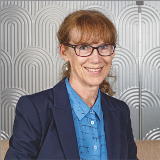
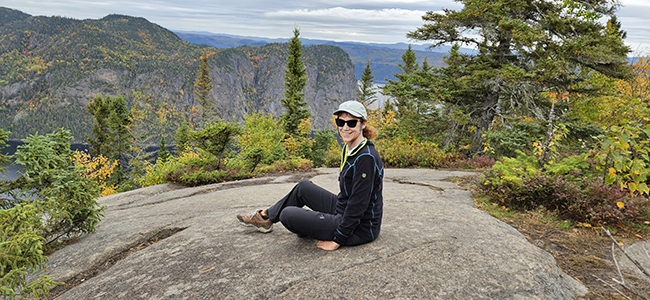
In her first president’s address at Geoscientists Canada’s annual general meeting (AGM) on June 11, long-time APEGA registrant Darcie Greggs, PhD, FGC, FEC (Hon.), P.Geol., presented a blunt assessment of the current educational landscape: there’s a declining number of students studying geoscience at university, raising the risk of not having enough professional geoscientists to execute the national strategic plan.
APEGA Council President Dean Mullin, P.Eng., and Registrar and CEO Paul Wynnyk, P.Eng., joined Greggs at her AGM address in Saint John, New Brunswick, and hosted her at APEGA’s head office two weeks later, where she spoke to staff. In both speeches, Greggs also provided part of the solution, drawn from her own educational experience: to increase the potential of the geoscience profession, we need to widen the prospect pool and include new voices, whether by encouraging alternative points of view or listening to different ways of knowing and thinking. “Across scientific fields, eureka moments often come from those with different perspectives,” Greggs points out.
Geological timeline
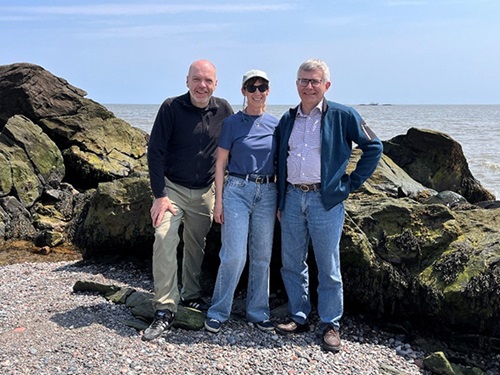
When Greggs was growing up in the 1960s, her geologist father had a career with Shell that took him from Vancouver to Calgary and then Edmonton, before he started a teaching career at Queen’s University in Kingston, Ont. Because academia didn’t pay as well back then, he’d find work as a field geologist in the summers, often working on horseback, investigating bedrock and deposits exposed by highway expansions in the wilds of Canada and the United States. “There were no cell phones, no satphones, but we might get the occasional letter,” Greggs recalls.
One summer, tired of being away from dad, they all piled into the family car to join him on a summer-long work camping trip. “It was a lot of work for mom because dad was working every day, so we kids spent a lot of time hanging out in ditches, being annoying. But it was a great family memory.”
Under her parents’ academic influence, Greggs enrolled at Queen’s University. She didn’t take geology at first, though, because “at the time, it was more societally acceptable for a woman to take biology.” Partway through her degree, she found herself working a summer job caring for and feeding university laboratory mosquitoes, and realized biology was not the life for her. “I can tell you: the mosquitoes were feeding on me!”
A supportive mentor
Greggs also combatted societal norms early in her time as an APEGA registrant, when with guidance from Dr. Gordon Williams, P.Geo.—a friend of her father, an APEGA past-president, and the first president of Geoscientists Canada—Greggs volunteered with APEGA’s Inclusivity Task Force. “Gordon was a staunch supporter of inclusivity. Part of his mentoring was saying, since I had the interest, I should volunteer in many capacities, so he encouraged me to get involved,” Greggs explains.
At one of her first meetings as a speaker, Greggs says some men were “flabbergasted” that a visibly pregnant woman had come to speak to them, and that unaware attendees regularly asked her for the washroom key. Happily, Greggs has seen a “terrific evolution” over the years, both in how APEGA supports all registrants, and how much registrants reach out to their communities in “increased numbers and with enthusiastic buy-in at every level.”
Digging deep
During her AGM address, Greggs quoted a recent piece by Andrew Ng, founder of DeepLearning.AI and adjunct professor at Stanford University, who was reacting to the May 2026 Harvard University announcement about combatting “grade inflation” by limiting the number of A grades given in undergraduate classes. Ng, like Greggs, feels like this is the wrong direction for higher education and proposes something different. He suggests permitting an unlimited number of retries for graded assignments, and assigning practical homework that helps students practice and learn, rather than simply assessing their skills.
Ng’s view is that, instead of capping the number of A grades doled out to ensure only “elite” students receive them, universities should “set a high bar and teach elite, cutting-edge skills, but strive relentlessly to help everyone succeed. This way, eliteness is defined not by excluding people but by helping as many people as possible to be excellent.”
Greggs admits she struggled at first in her own post-secondary experience. She was an early, avid reader in a small-town school, so the grade-school coursework came easily, but she didn’t have to figure out how to process more complex information, as she was challenged to do when she started university. Greggs identifies this as an issue in geoscience education to this day, and she worries that efforts to find “the best and the brightest” as early as possible could discourage students who don’t immediately stand out. “From my journey in education, ‘the best and the brightest’ means students who are really good at thinking the same way instructors think when taking their tests. I was never one of those students,” she adds, laughing.
Greggs emphasizes that she’s not advocating for watering down technical courses or inflating grades, because “when geoscientists and engineers get it wrong, the results can be catastrophic.” But she knows an obsession over finding the “best” young students and culling the rest can discourage those who think differently—and it’s often out-of-the-box thinkers who end up leading the way, especially in professions like geoscience. Earlier in her career, at an APEGA past-presidents’ meeting with highly regarded industry professionals, attendees talked openly about how no one in the room went into their undergrad with an average of more than 70 per cent. “And yet here they were, running the world!”
Building blocks for the future
Despite the challenges that have been leading to declining numbers of geoscience students, Greggs sees positives. APEGA’s new competency-based assessment process for professional geoscientist applicants looks beyond the grades of new grads and will facilitate interprovincial mobility. She’s also a fan of a strategy used by universities in Atlantic Canada wherein students study for a year at one university then move to another, so they learn from a variety of experts at different institutions.
As she begins her one-year term, Greggs is grateful she isn’t alone. “I have an entire board of directors with me, 10 CEOs and member regulators, 10 member presidents, and Geoscientists Canada’s own CEO—and this is a very collaborative group with incredible academic, work, and life experience,” she says.
“I often think back to something [APEGA Past-President] Terri Steeves said at the 2025 [APEGA Council] strategic retreat when she summed up the responsibilities of a board: insight, oversight, and foresight. Those three things really resonated with me, because the world is changing incredibly quickly, and nobody can be an expert in everything. What I'm seeing now, with the [APEGA] volunteers, the branch folks, council, and the various committees is that people are really listening to each other, not just waiting until somebody stops talking, and that collaboration is moving us forward incredibly well.”